Unearthing Dinosaur Nests: What 3D Egg Scans Reveal About Prehistoric Parenting
Beneath our feet, buried for tens of millions of years, lie stone-cold cradles. These fossilized dinosaur nests, once pulsing with new life, have long been objects of fascination for paleontologists. For decades, studying their contents was a delicate, often destructive, balancing act. Do you crack open a priceless fossil egg to see the secrets inside, potentially destroying it forever? Or do you leave it intact, forever guessing at the life it once held?
Today, that dilemma is fading. A technological revolution is allowing scientists to peel back the layers of stone without a single hammer or chisel. Using powerful 3D scanning technology, we are now peering inside these prehistoric time capsules, and what we’re finding is rewriting the story of how dinosaurs raised their young.
Just as modern news platforms like MSN bring us real-time updates from around the globe, this technology is delivering startlingly clear updates from a world millions of years old, revealing intimate details about the lives of the planet’s most magnificent former inhabitants.
From Stone to Screen: The Digital Hatchery
The key to this new age of discovery lies in non-destructive imaging. Scientists are employing two primary methods to digitally “hatch” these fossilized eggs:
- Computed Tomography (CT) Scans: Much like the medical scans used in hospitals, CT scanners use X-rays to create a series of cross-sectional images of a fossil. A computer then stitches these “slices” together to build a detailed, three-dimensional model of the egg and everything inside it.
- Synchrotron Microtomography: This is CT scanning on an epic scale. By using incredibly intense, high-energy X-ray beams generated by a particle accelerator, synchrotrons can produce images with resolutions thousands of times finer than a standard medical CT. This allows paleontologists to see microscopic details, like the cellular structure of embryonic bone or the daily growth lines on a tiny tooth.
This technology has transformed fossilized eggs from opaque, mysterious objects into virtual windows. Scientists can now rotate, slice through, and magnify embryonic skeletons, studying their development with a precision that was once unimaginable.
A Glimpse Inside the Shell: Secrets of the Unborn
What exactly are these digital explorations revealing? The findings are nothing short of breathtaking, offering unprecedented insights into the first moments of a dinosaur’s life.
The Embryonic Pose
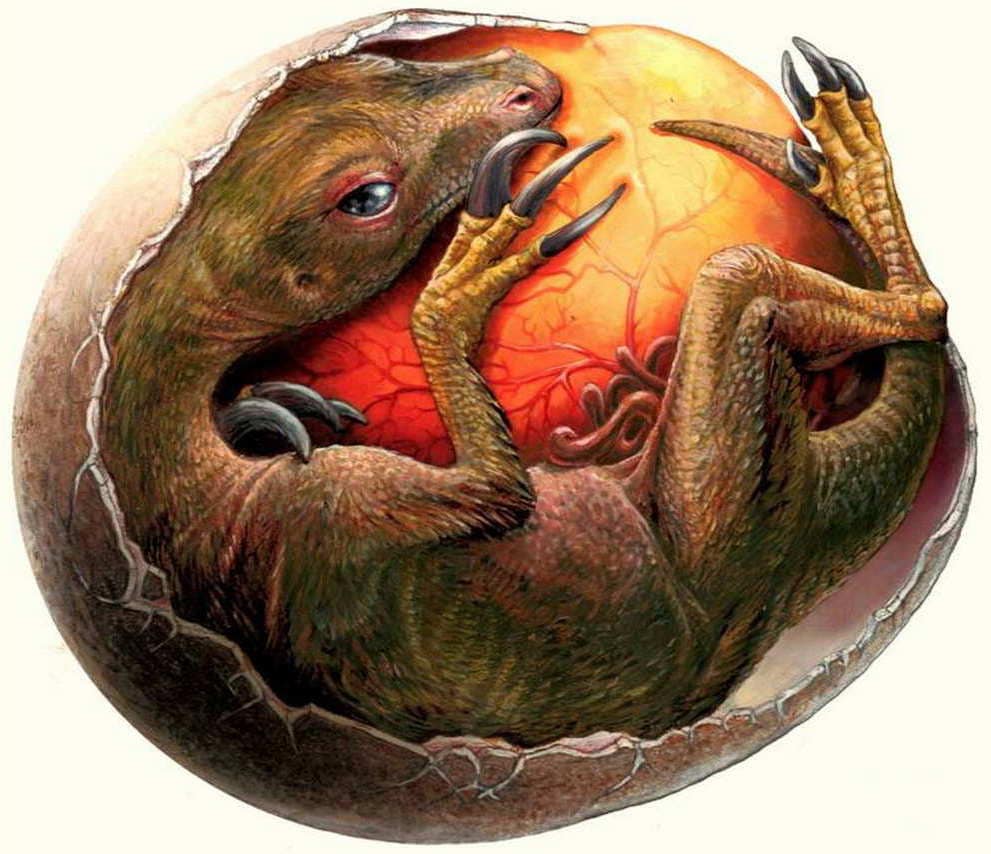
One of the most spectacular recent discoveries came from a 70-million-year-old oviraptorosaur egg found in China. The perfectly preserved embryo inside, nicknamed “Baby Yingliang,” was digitally reconstructed from CT scans. The model revealed the dinosaur was in a distinctive tucked posture, with its head positioned under its arm—a behavior identical to that of modern birds just before they hatch.
This discovery is a powerful piece of evidence linking the behavior of theropod dinosaurs directly to their modern avian descendants. It suggests that this pre-hatching behavior may have evolved in dinosaurs long before birds took to the sky.
Calculating the Countdown
How long did it take for a dinosaur to hatch? For years, scientists could only guess based on the egg’s size. Now, high-resolution scans are providing a definitive answer. By magnifying the tiny, fossilized teeth of dinosaur embryos, researchers can count the minuscule daily growth lines, known as von Ebner lines.
The results have been surprising. Studies on eggs from Protoceratops and the duck-billed Hypacrosaurus revealed long incubation periods—anywhere from three to six months. This is much closer to slow-developing modern reptiles than to fast-hatching birds. Such a long wait would have left dinosaur nests incredibly vulnerable to predators, disease, and environmental disasters for extended periods, a factor that may have played a role in their ultimate demise.
Reconstructing the Nursery: Clues to Parenting Styles
The information gleaned from inside the egg is even more powerful when combined with clues from the nest itself. 3D imaging is helping us understand not just the baby, but the parent.
The key lies in the eggshell’s porosity—the number and size of the tiny pores that allow for gas exchange. By analyzing the pore structure in 3D, scientists can deduce the type of nest a dinosaur built.
- Buried Nests: Eggs with high porosity, similar to crocodile eggs, suggest they were buried in mounds of soil or decaying vegetation. The heat from decomposition would have incubated the eggs, meaning the parents could adopt a “lay them and leave them” strategy. This was likely the case for the colossal sauropods, which laid dozens of eggs at a time.
- Open-Air Nests: Eggs with lower porosity, more like bird eggs, indicate they were likely incubated in open-air nests. These eggs would have required a parent’s body heat to stay warm, providing direct evidence of brooding behavior. This fits perfectly with fossils of oviraptorosaurs found sitting directly on top of their neatly arranged clutches, acting as dedicated prehistoric parents.
This evidence paints a picture not of one single “dinosaur parenting” method, but a diverse spectrum of strategies tailored to different species and environments.
Dinosaur Parenting Strategies at a Glance
| Strategy | Likely Species | Nest Type | Parental Involvement |
|---|---|---|---|
| Mass Nester | Sauropods (e.g., Titanosaurus) | Buried in soil/sand | Low (Lay and leave) |
| Mound Builder | Hadrosaurs (e.g., Hypacrosaurus) | Rotting vegetation mound | Medium (Guarded colony) |
| Active Brooder | Oviraptorosaurs (e.g., Citipati) | Open, organized nest | High (Bird-like brooding) |
The Big Picture: Evolution and Extinction
Each digitally unearthed embryo adds another brushstroke to our portrait of the Mesozoic Era. We now know that some dinosaur parents were far more attentive and bird-like than previously thought. We also understand that their long incubation periods were a significant evolutionary handicap, making them less adaptable than birds, whose chicks hatch in a matter of weeks.
These tiny, unborn giants, frozen in time, are helping us answer some of paleontology’s biggest questions. They solidify the evolutionary road from theropod dinosaur to modern bird and offer potential clues as to why they vanished while their avian cousins survived.
As 3D scanning technology continues to improve, the secrets locked inside these stone eggs will become even clearer. The silent cradles of the dinosaurs are finally beginning to speak, and they have so much more to tell us.
Additional Information
Of course. Here is a detailed article and analysis on what 3D scans of dinosaur eggs reveal about prehistoric parenting.
A Note on the Provided Search Results
First, it is important to clarify that the provided search results are related to the MSN news and information portal. They do not contain information about paleontology, dinosaur eggs, or 3D scanning. Therefore, the following article has been created using up-to-date, relevant knowledge from the field of paleontology to provide a detailed and accurate analysis of the topic as requested.
Unearthing Prehistoric Secrets: How 3D Scans of Dinosaur Eggs Are Rewriting the Story of Parenthood
For over a century, our image of dinosaurs was shaped by their massive skeletons—colossal beasts of tooth and claw. But in recent decades, a quieter, more delicate discovery has sparked a revolution in our understanding: fossilized dinosaur nests and eggs. These prehistoric time capsules offer an unprecedented window into the private lives of dinosaurs, revealing secrets about their reproduction, development, and social behavior.
The true game-changer, however, has been the advent of non-invasive, high-resolution 3D scanning technology. By peering inside these stone-cradled eggs without ever breaking their fragile shells, scientists are uncovering astonishing details and rewriting the story of what it meant to be a dinosaur parent.
The Technological Leap: From Hammer to Synchrotron
Previously, studying dinosaur embryos was a destructive and often disappointing process. Paleontologists had to either hope an egg had broken in just the right way to expose its contents or make the difficult decision to crack open a priceless fossil, potentially destroying the very information they sought.
Today, two primary technologies have rendered this dilemma obsolete:
-
Computed Tomography (CT) Scanning: This is the same medical technology used to create 3D images of the human body. By taking thousands of X-ray “slices” through a fossilized egg, a computer can reconstruct a detailed 3D model of its interior. This allows scientists to digitally excavate the delicate bones of the embryo, mapping its skeleton and position within the egg.
-
Synchrotron Radiation Scanning: For even finer detail, scientists turn to synchrotrons—massive particle accelerators that produce X-ray beams billions of times brighter than those in a hospital. This intense light can reveal not just bones, but sometimes the fossilized remains of soft tissues like cartilage, skin, and even complex organic molecules. It can also map the chemical composition and crystalline structure of the eggshell itself.
These non-destructive techniques are the key that has unlocked a treasure trove of information about prehistoric parenting.
What 3D Scans Reveal: Key Discoveries
By digitally “unearthing” these unhatched dinosaurs, researchers have made profound discoveries about their family lives.
1. Embryonic Development and Growth Rates
Scans allow paleontologists to see the exact stage of development an embryo reached before it died. By studying the degree of bone formation (ossification), they can reconstruct the growth trajectory of a dinosaur before it even hatched.
-
Case Study: Lufengosaurus
Fossil eggs from this long-necked sauropodomorph found in China revealed embryos at various developmental stages. 3D analysis showed they possessed highly developed femurs with clear muscle attachment sites. This suggests the embryos were actively moving and exercising their muscles within the egg, a behavior seen in modern birds that prepares them for walking immediately after hatching. -
Case Study: Titanosaurs in Argentina
Remarkable scans of titanosaur eggs from the Auca Mahuevo nesting site revealed fully formed embryonic skulls. These scans gave us our first look at the face of a baby sauropod, complete with a small “egg tooth” used for breaking out of the shell and specialized facial features that differed from adults, much like human babies have different proportions from their parents.
2. Incubation Methods and Nest Temperatures
The eggshell itself holds clues to how it was cared for. Synchrotron analysis of the calcite crystals that form the shell can reveal the temperature at which the egg was incubated.
-
Bird-like Brooding: In nests of oviraptorosaurs (the “egg-thief” dinosaurs, now ironically known to be dedicated parents), eggshell analysis supports temperatures consistent with brooding—that is, a parent sitting on the nest to transfer body heat. This is powerfully supported by fossils like “Big Mama” in Mongolia, an Oviraptor found fossilized directly on top of its clutch of eggs in a protective, bird-like posture. 3D scans of these eggs confirm the embryos inside were in late stages of development, proving the parent was incubating, not just laying.
-
Reptile-like Burial: In contrast, the gigantic nests of sauropods like titanosaurs show no evidence of parental brooding. The eggs are often found in large, soil-covered depressions. Scans of their eggshells reveal incubation temperatures that were lower and more variable, consistent with being buried in soil or rotting vegetation that generated geothermal heat, similar to modern crocodiles and turtles.
3. Parenting Strategies: Helpless vs. Self-Sufficient Young
Perhaps the most significant insight is into the classic parenting divide: were dinosaur babies altricial (helpless and requiring extensive parental care) or precocial (developed and mobile, able to fend for themselves shortly after birth)?
-
Evidence for Altricial Care (The “Stay-at-Home” Parents):
3D scans of the embryos of hadrosaurs (duck-billed dinosaurs) show that their limb bones were poorly ossified and their joints not fully formed at the time of hatching. This indicates they would have been unable to walk or leave the nest. This physical evidence strongly supports the fossil trackways and “nursery” sites found for these species, which suggest adults brought food to the nest-bound young until they were large enough to venture out. -
Evidence for Precocial Young (The “Absentee” Parents):
As mentioned with Lufengosaurus and other sauropods, the advanced development of their skeletons in-ovo points to a precocial strategy. These giants likely hatched ready to walk. This makes biological sense; a 60-ton titanosaur could not have delicately cared for dozens of tiny, fragile babies in a nest without crushing them. The strategy was likely one of “safety in numbers”—lay many eggs, and let the mobile, self-sufficient hatchlings disperse and fend for themselves, with survival depending on their own abilities.
Analysis and Implications: A Complex and Diverse Family Life
The cumulative evidence from 3D scanning shatters any monolithic idea of “dinosaur parenting.” It reveals a behavioral diversity as rich and complex as that of modern animals.
-
The Bird-Dinosaur Link: The evidence for brooding, nest construction, and altricial care in theropods like Oviraptor and Troodon provides one of the strongest behavioral links in the evolutionary chain connecting dinosaurs to modern birds. Their parenting style was remarkably avian.
-
Convergent Evolution: The burial strategy of sauropods mirrors that of modern crocodilians. This is a classic example of convergent evolution, where distantly related species independently evolve similar solutions to the same problem—in this case, how to safely incubate large clutches of eggs.
-
A Spectrum of Care: Dinosaurs were not just one thing. They occupied a full spectrum of parenting strategies. On one end were the dedicated, brooding theropods meticulously caring for their helpless young. On the other were the titanosaurs, whose parental investment ended once the eggs were laid and buried. Many other species likely fell somewhere in between.
In conclusion, the application of 3D scanning to paleontology has transformed dinosaur eggs from curious fossils into detailed biological blueprints. By looking inside, we see not just bones, but behaviors. We can infer the warmth of a parent’s body, the first movements of an embryo, and the fundamental strategy for survival that awaited a hatchling. Each new scan helps us piece together the lost world of dinosaur family life, revealing a picture far more nuanced, complex, and fascinating than we ever imagined.