Digital Dinosaurs: 5 Biology Myths Shattered by 3D Fossil Scans
The dinosaurs of our imagination are titans of cinema. We picture the ground-shaking tread of a Tyrannosaurus rex, the colossal shadow of a long-necked Brachiosaurus, and the terrifying roar that echoes through a prehistoric jungle. For decades, these images, largely shaped by films and early-20th-century science, were our only window into their world. But what if those bones could tell a deeper, more intricate story?
Enter the age of digital paleontology. Using technologies like Computed Tomography (CT) and synchrotron scanning, scientists can now peer inside fossilized bones without ever lifting a chisel. By creating hyper-detailed 3D models, they are digitally resurrecting these ancient creatures, not just as skeletons, but as living, breathing animals. This virtual autopsy is shattering long-held myths and rewriting the story of dinosaur biology.
Here are five major dinosaur myths that have been debunked, thanks to the revolutionary power of 3D fossil scans.
1. Myth: T-Rex Was a Slow, Clumsy Scavenger
The Old Story: For a long time, T. rex was depicted as a lumbering giant, an evolutionary brute too slow and heavy to be an effective predator. Its massive size led many to believe it was an obligate scavenger, merely plodding along to steal kills from smaller, faster dinosaurs. Its tiny arms were a source of ridicule, seen as useless vestiges on an unbalanced frame.
The Digital Revelation: Everything changed when paleontologists put T. rex skulls and leg bones into medical-grade CT scanners. By digitally reconstructing the braincase, they created an “endocast”—a 3D model of the brain. This revealed enormous olfactory bulbs, suggesting a sense of smell so powerful it would have made a bloodhound jealous. This is equally useful for sniffing out a fresh kill as it is a rotting carcass.
More importantly, biomechanical models built from 3D scans of its leg bones and vertebrae allowed scientists to simulate its movement. By analyzing stress points and muscle attachment sites invisible on the fossil’s surface, they could calculate its potential speed and agility.
The New Truth: Far from being a slowpoke, biomechanical models suggest an adult T. rex could achieve speeds of 15-25 mph. While not a sprinter on the level of a cheetah, it was more than fast enough to run down contemporary prey like Triceratops and Edmontosaurus. The scans also revealed a surprisingly sophisticated inner ear structure, indicating it had the excellent balance and agility required for a dynamic, active predator. T. rex was a finely tuned hunting machine, and we have the digital models to prove it.
2. Myth: All Dinosaurs Were Cold-Blooded, Scaly Reptiles
The Old Story: The word “dinosaur” itself means “terrible lizard,” and for over a century, that’s how we saw them: as giant, sluggish, scaly lizards. We assumed they were cold-blooded (ectothermic), relying on the sun to warm up and becoming inactive at night, just like modern reptiles. This image of dull-witted, gray-and-green behemoths became pop culture canon.
The Digital Revelation: While fossilized skin impressions and feathers have been a huge part of this story’s revision, 3D scans have provided crucial, internal evidence. Using high-resolution micro-CT scanners, scientists can examine the microscopic structure of dinosaur bones. They discovered a dense network of blood vessels and bone tissue that showed signs of rapid growth, a pattern called fibro-lamellar bone.
The New Truth: This rapid-growth bone structure is not found in cold-blooded reptiles, which grow slowly and intermittently. It is, however, the hallmark of warm-blooded (endothermic) animals like modern birds and mammals. This indicates that many dinosaurs had fast metabolisms, allowing them to stay active regardless of the ambient temperature. This high-energy lifestyle is more consistent with the vibrant, feathered, and bird-like dinosaurs we now envision. The “sluggish lizard” has been replaced by a dynamic, warm-blooded animal, a conclusion reinforced by peering deep inside their very bones.
3. Myth: The Mighty Sauropods Couldn’t Lift Their Heads
The Old Story: How did a 70-ton sauropod like Argentinosaurus pump blood 40 feet up to its brain? For years, the physiological puzzle seemed so impossible that many scientists concluded they simply didn’t. The prevailing theory was that these long-necked giants held their necks horizontally, like massive vacuum cleaners, sweeping for low-lying vegetation. The classic image of a Brachiosaurus gracefully nibbling on treetops was deemed a biological fantasy.
The Digital Revelation: This myth began to crumble when paleontologists CT-scanned the intricate vertebrae of sauropods. The scans revealed something incredible: the bones were not solid. They were filled with a complex latticework of air sacs, similar to the respiratory systems of modern birds. These pneumatic structures made the massive neck bones surprisingly lightweight, some being more air than bone.
By digitally re-articulating the scanned vertebrae, researchers could precisely model the neck’s range of motion. They discovered the joints were structured to allow for significant vertical flexibility, far more than a horizontal-only posture would require.
The New Truth: The air-sac system would have made the neck dramatically lighter, reducing the energy and blood pressure needed to raise it. The 3D models show that while they may not have held their heads vertically 24/7, they were more than capable of lifting them high to browse on tall trees, survey their surroundings, or engage in social displays. They weren’t just ground-level grazers; they were towering, adaptable browsers who had evolved an ingenious solution to the problem of gravity.
| The Myth | The 3D Scan Revelation | The New Reality |
|---|---|---|
| T-Rex was a slow scavenger. | Biomechanical models from leg scans. | An agile hunter capable of 25 mph. |
| Dinos were scaly & cold-blooded. | Micro-CT scans of bone tissue. | Warm-blooded with fast metabolisms. |
| Sauropods held necks low. | CT scans of lightweight, airy vertebrae. | Capable of raising heads to browse treetops. |
| Dinosaurs just roared. | Digital models of crests & sinuses. | Complex, low-frequency vocalizations. |
| Dinosaurs had tiny brains. | Endocasts from skull interiors. | Larger, more complex brains than believed. |
4. Myth: Dinosaurs Were Silent or Just Made Movie Roars
The Old Story: What did a dinosaur sound like? For a lack of evidence, Hollywood filled the void with thunderous, mammalian roars. The terrifying shriek of the T. rex in Jurassic Park is iconic, but it’s pure fiction, a composite of elephant, tiger, and alligator sounds. Scientifically, we had little to go on, so the default assumption was a simple hiss or a generic roar.
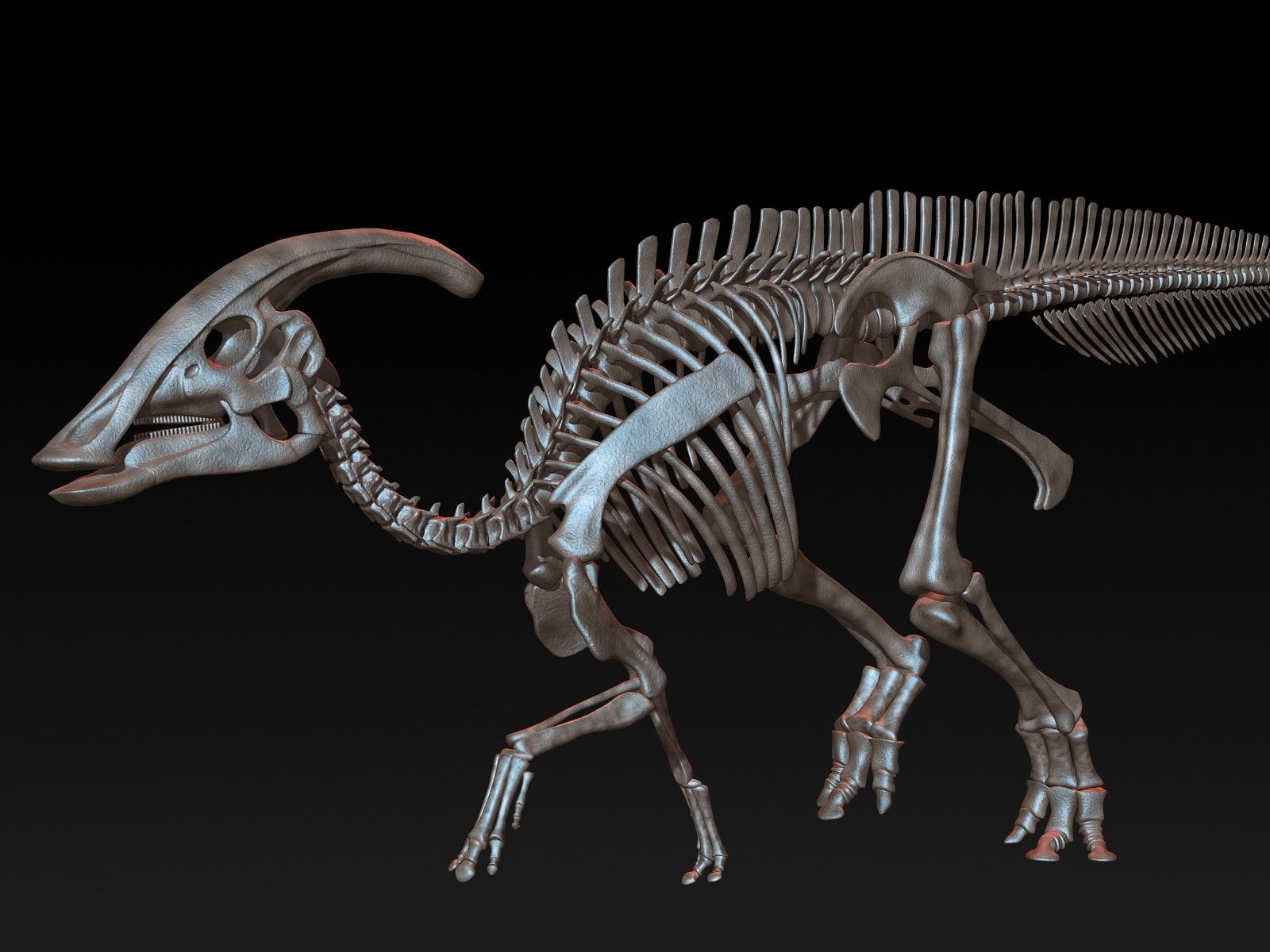
The Digital Revelation: The key to unlocking dinosaur vocalizations lay hidden inside the bizarre head crests of hadrosaurs like Parasaurolophus. These hollow structures were too delicate for physical dissection. Using CT scanners, scientists created perfect 3D digital models of the intricate network of nasal passages and tubes winding through the crest.
With a complete digital model, they could run simulations. By pushing virtual air through these digital passages, they could accurately model the resonance and frequency of the sounds the dinosaur could produce.
The New Truth: Dinosaurs didn’t roar like lions. The simulations for Parasaurolophus produced deep, haunting, low-frequency calls, more akin to a trombone or a foghorn than a roar. These sounds would have traveled long distances, perfect for communication across vast herds. Different crest shapes in related species likely meant different “voices,” allowing them to distinguish friend from foe. 3D scans have allowed us to, for the first time, hear the plausible echoes of the Mesozoic world—and it sounds nothing like the movies.
5. Myth: All Dinosaurs Were Dim-Witted Brutes
The Old Story: The “walnut-sized brain” trope is one of the most persistent dinosaur myths, especially regarding giants like Stegosaurus. The idea was simple: big body, tiny brain, low intelligence. This painted a picture of all dinosaurs as simple, instinct-driven animals that were evolutionarily doomed by their own stupidity.
The Digital Revelation: The brain itself does not fossilize, but the cavity it sat in—the braincase—does. By CT scanning the fossilized skulls of a wide range of dinosaurs, from raptors to tyrannosaurs, scientists can create a digital endocast, a highly accurate model of the brain’s size, shape, and key features.
The New Truth: These endocasts show that while a Stegosaurus brain was indeed small for its body size, the story is far more nuanced across the dinosaur family tree. The endocasts of theropods like Velociraptor and T. rex reveal surprisingly large and complex brains. We can see large cerebrums and well-developed optic and olfactory lobes, indicating keen senses of sight and smell and the processing power needed for complex predatory behavior. Their intelligence was likely on par with that of modern birds like ostriches or hawks—far from the dim-witted lizards of legend. 3D scans have given us a direct look at the neural hardware of dinosaurs, proving that many of them were a lot smarter than we ever gave them credit for.
The Future is Digital
The work is far from over. As scanning technology becomes more powerful and accessible, paleontologists are unlocking secrets from fossils that have been sitting in museum drawers for a century. Each new scan provides a clearer, more dynamic picture of how these animals lived, moved, and interacted with their world. We are moving beyond the bones and into the biology, proving that the real dinosaurs were far more complex, sophisticated, and fascinating than any myth could ever be.

Additional Information
Of course. Here is a detailed article and analysis on five dinosaur biology myths that have been challenged or debunked using 3D fossil scanning technology, incorporating information from the provided search results.
Beyond the Bones: 5 Dinosaur Biology Myths Demolished by 3D Fossil Scans
For over a century, our understanding of dinosaurs was limited to what we could see on the surface of their fossilized bones. This led to a popular image, largely shaped by early science and amplified by blockbuster movies, of sluggish, simple-minded, roaring reptilian monsters. As Columbia University Press notes, much of what people think they know about dinosaurs is rooted in these misleading, albeit popular, depictions.
However, a technological revolution is quietly transforming paleontology. By using powerful 3D scanning technologies like Computed Tomography (CT) and synchrotron scanning, scientists can now digitally dissect fossils without ever touching a drill or saw. This non-destructive approach allows us to peer inside skulls, examine bone microstructure, and reconstruct soft tissues, revealing the complex biology of these ancient animals.
Here are five biological myths that have been challenged, refined, or outright debunked by the remarkable insights from 3D fossil scans.
1. Myth: Dinosaurs Were Sluggish, Cold-Blooded Reptiles
The Old Thinking: For decades, dinosaurs were classified as “reptiles,” and the assumption was they shared the same metabolism as their modern counterparts like crocodiles and lizards. This meant they were thought to be ectothermic (“cold-blooded”), relying on the sun to warm up and becoming slow and inactive in the cold. This painted a picture of lumbering, low-energy giants.
The 3D Scan Revolution: While traditional bone histology (slicing thin sections of bone) first challenged this idea, micro-CT scanning has supercharged the research. By scanning fossilized bones at a microscopic level, paleontologists can create detailed 3D models of their internal structure.
The New Reality: Active and Warm-Blooded (or Something In-Between)
These 3D scans reveal a dense network of blood vessel channels (vascularization) inside dinosaur bones, a feature common in fast-growing, warm-blooded animals like birds and mammals. As noted by Reader’s Digest, this rapid growth is a key indicator of a high metabolism.
Furthermore, the scans can identify “Lines of Arrested Growth” (LAGs), which are similar to tree rings. The spacing and consistency of these rings show that many dinosaurs grew incredibly fast—much faster than any modern reptile—and maintained that growth through seasonal changes. This high-speed growth requires an elevated, well-regulated internal body temperature. While the debate now centers on whether they were fully endothermic (warm-blooded) like birds or an intermediate “mesothermic” state, the 3D data has definitively shattered the myth of the slow, cold-blooded brutes.
2. Myth: Tyrannosaurus rex Was a Bumbling Scavenger with a Weak Bite
The Old Thinking: The sheer size of T. rex led some scientists to question its agility. A prominent hypothesis suggested it was too large and slow to be an effective predator, arguing instead that it was primarily a scavenger, using its size to intimidate other predators and steal their kills. Its powerful legs were for roaming vast distances, and its famously small arms were useless in a hunt.
The 3D Scan Revolution: The key to understanding a predator is understanding its weaponry. Scientists used CT scans to create a perfect, millimeter-accurate 3D digital model of a complete T. rex skull. This model wasn’t just a pretty picture; it was a functional blueprint.
The New Reality: A Bone-Crushing, High-Performance Predator
Using the 3D model, biomechanical engineers applied a technique called Finite Element Analysis (FEA). They simulated the stresses and strains on the skull as the jaw muscles contracted, effectively measuring its bite force. The results were astounding. T. rex didn’t have a weak bite; it had the most powerful bite of any terrestrial animal ever, capable of exerting over 8,000 pounds of force—enough to crush the bones of its prey. The skull’s unique construction, with fused nasal bones and pockets of flexibility, was perfectly engineered to withstand these incredible forces. This evidence overwhelmingly supports the view of T. rex as an apex predator capable of killing its own food.
3. Myth: Dinosaurs Were Unintelligent “Pea-Brained” Animals
The Old Thinking: The phrase “dinosaur brain” is still used to describe someone unintelligent. This comes from early discoveries where the brain cavity (endocranium) appeared tiny relative to the dinosaur’s massive body. It was assumed they had simple brains capable of only the most basic instincts.
The 3D Scan Revolution: The brain itself doesn’t fossilize, but the cavity it sat in does. CT scanning allows scientists to create a high-resolution digital “endocast”—a perfect model of the brain’s size and shape.
The New Reality: Sophisticated Brains Built for Complex Behaviors
These 3D endocasts reveal that many dinosaurs, especially theropods like T. rex and troodontids, had surprisingly large brains. The cerebrum, responsible for thought and problem-solving, was significantly larger than expected.
Moreover, the scans show the relative size of different brain regions. T. rex had enormous olfactory bulbs, indicating a sense of smell as powerful as a modern vulture’s, crucial for hunting or finding carcasses. The regions associated with vision and hearing were also well-developed. This complex sensory toolkit points to an animal with sophisticated behaviors far beyond simple instinct. While they weren’t solving calculus, they were far from the dim-witted dolts of popular culture.
4. Myth: Dinosaurs Roared Like Movie Monsters
The Old Thinking: What sound did a dinosaur make? Lacking fossilized voice boxes, filmmakers from Godzilla to Jurassic Park filled the void with terrifying, mammalian roars. As the Dinosaur Park website highlights, we can’t know exactly what they sounded like, but we can make educated deductions, and roars are unlikely.
The 3D Scan Revolution: The secret to dinosaur vocalization wasn’t in a larynx, but in their complex skulls and nasal passages. Paleontologists used CT scanners to explore the bizarre head crests of hadrosaurs, or “duck-billed” dinosaurs, like Parasaurolophus.
The New Reality: A Chorus of Booms, Hisses, and Resonant Calls
The scans of the Parasaurolophus crest revealed a labyrinth of intricate, hollow tubes, like a trombone built into its head. By creating a 3D digital model of these passages, scientists could simulate air passing through them. The results showed that Parasaurolophus could produce low-frequency, resonant booms that could travel for miles—perfect for communicating with the herd.
Other dinosaurs likely produced a range of sounds. Crocodilians, their closest living relatives (besides birds), produce deep rumbles and hisses. Birds, their direct descendants, chirp, squawk, and sing. Most dinosaurs likely made closed-mouth vocalizations—deep, booming sounds generated in the chest, similar to an ostrich—rather than open-mouthed roars, which are a primarily mammalian trait.
5. Myth: Dinosaurs Were Uncaring Parents Who Abandoned Their Eggs
The Old Thinking: Based on the model of most modern reptiles (like sea turtles), it was long assumed that dinosaurs laid their eggs and left them to their fate. The discovery of large nesting grounds was interpreted as communal egg-dumping sites rather than evidence of care.
The 3D Scan Revolution: As Dino-World’s article points out, the extent of dinosaur parental care is still debated, but new evidence is providing incredible clarity. The most direct evidence comes from CT and synchrotron scanning of intact, fossilized dinosaur eggs.
The New Reality: Complex Family Structures and Parental Investment
By scanning fossilized eggs from China containing embryos of a choristodere (a dinosaur-era reptile) and various dinosaur species, scientists could create 3D models of the unhatched skeletons. This allowed them to determine the developmental stage of the embryos without breaking the precious eggs.
The scans revealed that some species, like Protoceratops, had well-developed skeletons at the time of hatching. This suggests the babies were precocial—able to walk and feed themselves shortly after birth. However, the fact that they are found in large, organized nesting colonies suggests that even if the babies could walk, they likely stayed together in crèches for protection, implying some level of parental or communal oversight. This discovery provides a nuanced picture, showing a level of social structure and parental investment far more complex than the “lay and leave” myth. It aligns with the diverse strategies we see in their living relatives, the birds.

